Second light: alpenglow, afterglow, and the Belt of Venus
Why the landscape lights up again after sunset — and how it all actually works
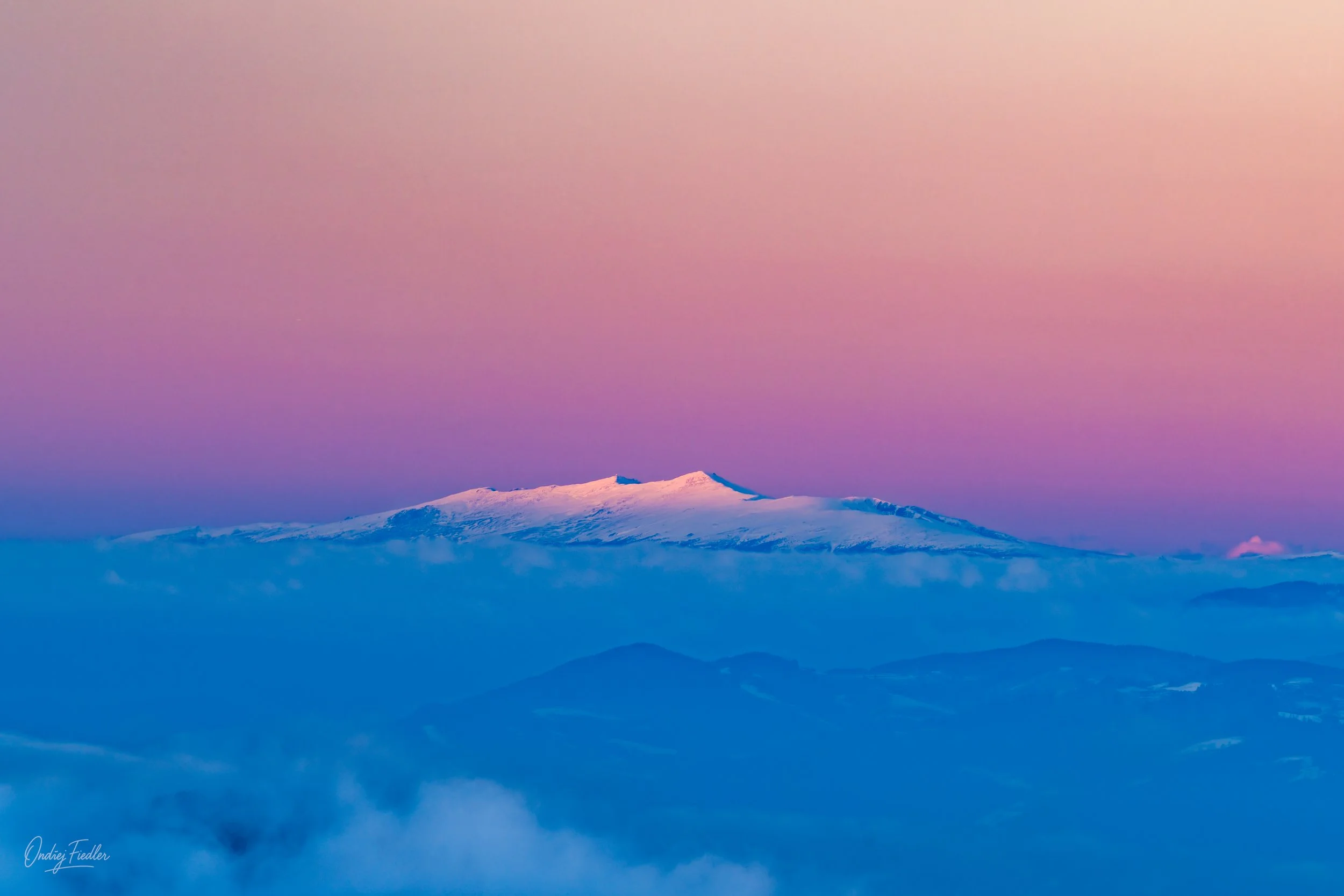
The moment photographers reach for the shutter again
The sun is down. The light has gone. You pack the tripod and prepare to leave. And then — five, ten, sometimes twenty minutes after sunset — it happens. The landscape lights up again. Mountain peaks start to glow pink. Clouds turn orange and violet. A pink band rises in the eastern sky. And shadows return to the valley — softer now, more colorful, somehow weightless.
Photographers call this "second light," and they love it. But under that one name hide three different phenomena that are related, but physically not the same thing. Let's pull them apart — and then look at why all of it works.
Why shadows return: the sky as a softbox
First, though, the thing every photographer notices in that moment, even if they can't quite name it: shadows return to the landscape. A few minutes after sunset, when you'd expect nothing but flat diffuse scatter, you suddenly see soft but clearly directional illumination. Grass is brighter on the side facing west. Trees cast long, blurred shadows. A west-facing wall of a house glows; the east-facing one sits in half-shadow.
This is not alpenglow, nor afterglow in the "color of the sky" sense. It's the functional consequence of afterglow for the entire landscape — and it deserves its own discussion, because for a photographer this is the working moment.
The mechanism
The sun is below the horizon, but it still illuminates the upper layers of the atmosphere above the western half of the sky. Specifically: when the sun is roughly 3° below the horizon, its direct rays still reach the atmosphere at altitudes of 10–15 km. There the light scatters on air molecules and aerosols, and a fraction of it travels back down toward the observer. From the perspective of someone in the valley below, it looks as though the entire western hemisphere of the sky has lit up.
That illuminated atmosphere behaves like a huge backlit panel — in a photographer's terms, a gigantic softbox, except instead of studio nylon it's several kilometers of troposphere and stratosphere.
Three properties of this "sky softbox"
It's enormous. It covers roughly half the visible sky. For comparison: a studio softbox is tens to hundreds of centimeters across. Here the effective source is hundreds of kilometers wide and tens of kilometers tall. A large source means soft shadows without sharp edges, smooth gradients. You can't build a lighting modifier at this scale.
It's directional. The western half of the sky is markedly brighter than the eastern — typically by 1 to 2 EV. Light therefore doesn't fall from all directions equally; it comes predominantly from one side. The landscape takes on directional character: west-facing surfaces are lit, east-facing ones sit in half-shadow. This is why you can still shoot classic landscape compositions with "directional light" long after the sun is gone.
It has an unusual spectrum. This is often overlooked, but photographically essential. The light coming from the illuminated atmosphere has a different spectral profile than daylight. Short blue wavelengths are heavily scattered by Rayleigh (which is why the sky overhead stays blue); long red wavelengths from the west pass through almost unaltered. But the middle of the spectrum — orange and yellow-red — is markedly attenuated because of ozone absorption in the stratosphere (the so-called Chappuis absorption band around 600 nm). At twilight, when light travels through the atmosphere at a very low angle, the optical path through the ozone layer is up to 30× longer than during the day — and Chappuis absorption is amplified accordingly. The result is bichromatic illumination: cool blue from above, warm red from the west, with a relative "gap" in the middle. That's why twilight landscapes have a specific look that doesn't appear at any other time of day — and one you can't fully recreate in post.
What this means for the photographer
The combination of soft + directional + bichromatically warm is why landscape photographers don't pack the tripod at sunset, but keep waiting.
During the day you have directional light, but it's hard — strong shadows, blown highlights, unmanageable contrast. With overcast skies you get soft light, but it's omnidirectional — everything looks flat, modeling is gone. During blue hour you have beautiful atmosphere, but the light is already too weak for detailed landscape work.
Only this short phase — typically 10–20 minutes after sunset — gives you both at once. Plus three bonuses:
Manageable dynamic range. Between the lit western sky and the shadowed landscape you'll usually find 5–8 EV. That's a range a modern sensor handles with bracketing or careful RAW exposure. Midday scenes routinely hit 12+ EV.
Long shadows with depth. Because the effective "source" sits in the plane of the horizon, shadows stretch far across the scene and build strong spatial structure — the landscape looks deeper.
Color contrast as a compositional tool. Bichromatic lighting produces specific blue-and-red contrasts between lit and shadowed surfaces. This can't be convincingly created in post — you either capture it or you don't.
And one non-technical bonus: most photographers have already left, the rest are taking selfies at the car. The landscape is often yours alone.
How long does it last
It depends on latitude and season:
Equator: very short, ~10 minutes. The sun drops vertically; the phase runs through quickly.
Central Europe (~50° N): 15–25 minutes in winter, 20–30 minutes in summer.
Northern Scandinavia or Iceland in summer: can last for hours — the sun "rolls" along the horizon very slowly. That's why subpolar summer nights are so iconic for landscape photography.
Subpolar winters: brief, but with an extremely long, low-angle light. The characteristic "Icelandic" look of winter landscape shots comes precisely from this.
After this phase the sky darkens uniformly, directionality disappears, the softbox "switches off", and blue hour begins — beautiful, but atmospherically contemplative rather than a working window.
Three phenomena people confuse
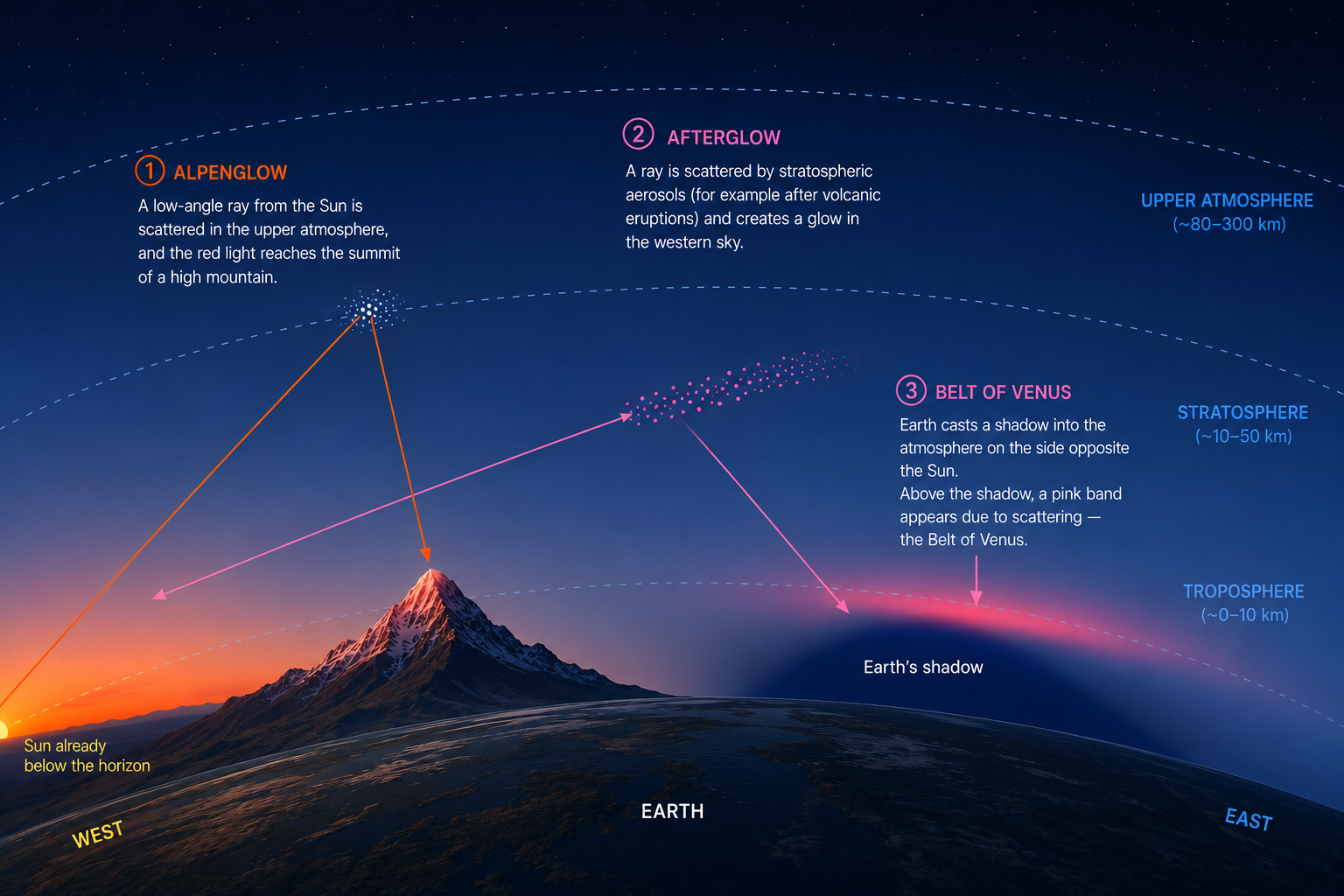
1. Alpenglow
When photographers say "the mountains caught pink," they're talking about alpenglow. It's the pink-orange to purple tint that appears on elevated terrain — peaks, rock walls, high clouds — shortly after sunset or before sunrise.
The key word is "indirect." From the perspective of an observer down in the valley, the sun is no longer above the horizon, but its rays still pass through the upper layers of the atmosphere. There they scatter, and some of that scattered light falls back down to earth — specifically, onto whatever stands highest. The peaks aren't lit by direct sunlight, but by scattered light from the atmosphere above them.
(A small terminological note: in Anglo-Saxon literature, "alpenglow" is often also used for the last direct rays just before sunset that paint the summits pink. Purists distinguish the two — true alpenglow is strictly the indirect light after sunset.)
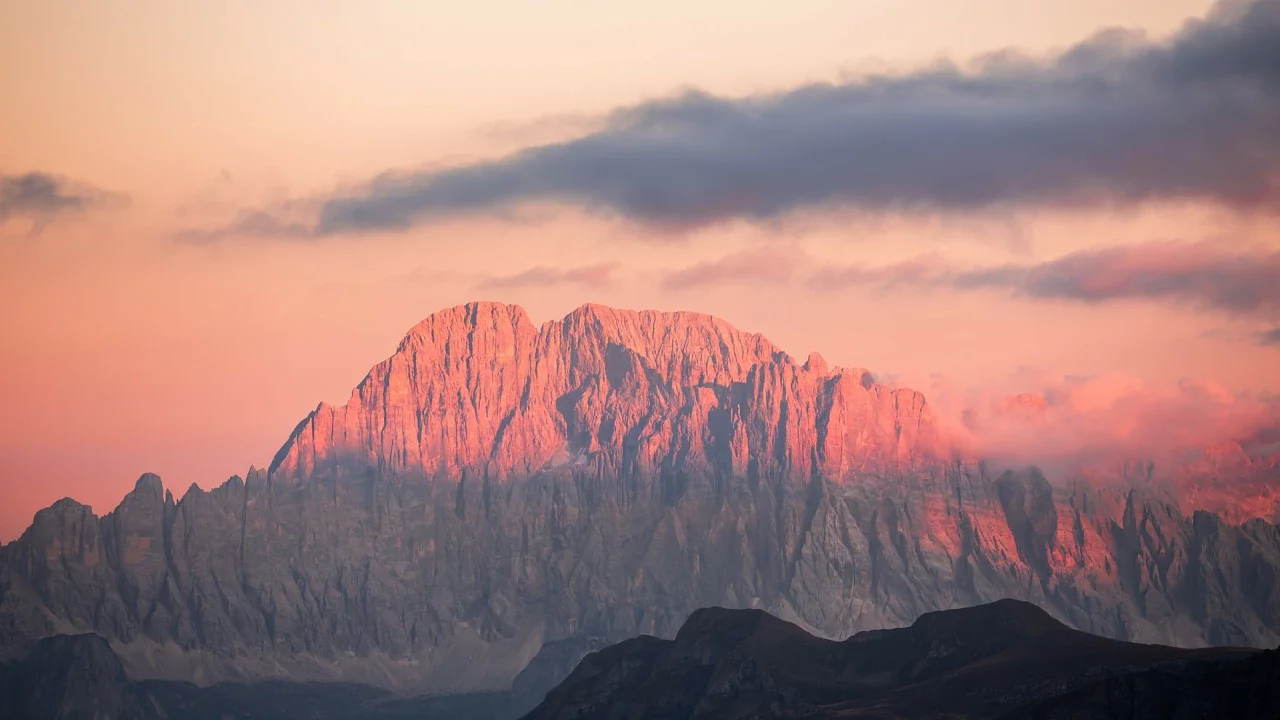
The Dolomites turn pink - Credit: Tobias Rademacher
2. Afterglow
Afterglow isn't on the ground but on the sky itself. It's the diffuse red-orange to purple glow in the western sky that hangs there for 20 to 40 minutes after sunset. It often has a banded structure and is most pronounced in good visibility and when there are more aerosols in the upper troposphere and stratosphere.
It's produced mainly by Mie scattering of sunlight on small particles high in the atmosphere, supplemented by Rayleigh scattering on the air molecules themselves. After major volcanic eruptions, afterglow can be extreme — we'll come back to that.
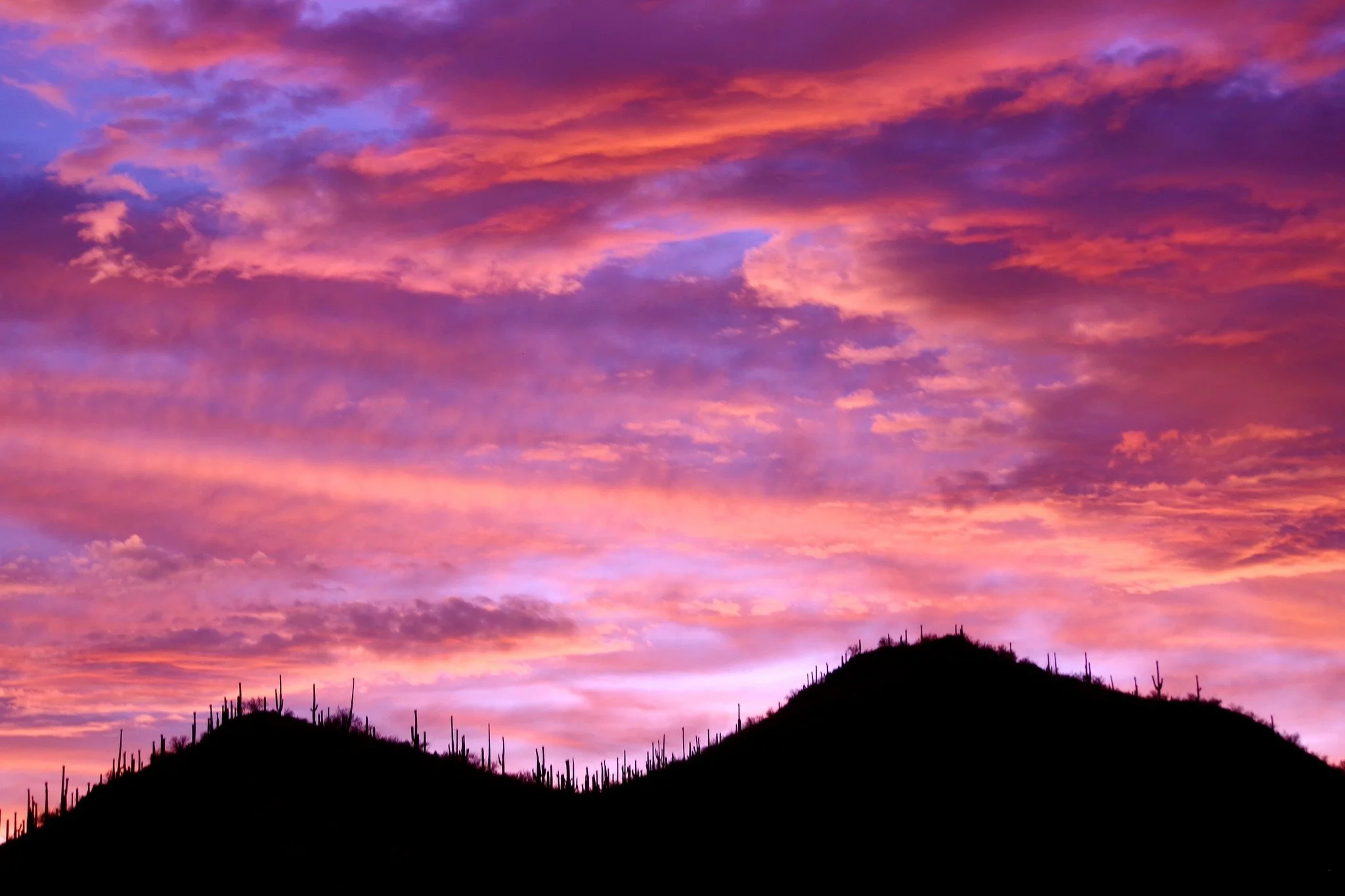
Afterglow - Credit: Douglas Taylor
3. The Belt of Venus
Then there's the Belt of Venus (sometimes called the "antitwilight arch"). This is a completely different direction — you look opposite to where the sun set.
Where the ground meets the sky in the east (after sunset) or in the west (before sunrise), you'll see a pink band about 10–20 degrees wide. Below it is a darker blue-gray stripe — that's the Earth's shadow itself, projected onto the atmosphere. The pink band above it is the part of the sky still lit by direct sunlight that has traveled a long path through the atmosphere and lost all its short wavelengths.
The Belt of Venus is essentially the "other side" of what's happening in the west. But unlike afterglow, it's geometrically tied to the position of Earth and Sun — you can watch it rise toward the zenith while Earth's shadow grows beneath it. This phenomenon was systematically measured and modeled by Raymond Lee in his 2015 study in Applied Optics, where he showed that the color and luminance extremes usually occur at different elevation angles — the brightest spot of the band isn't the same as the most saturated.
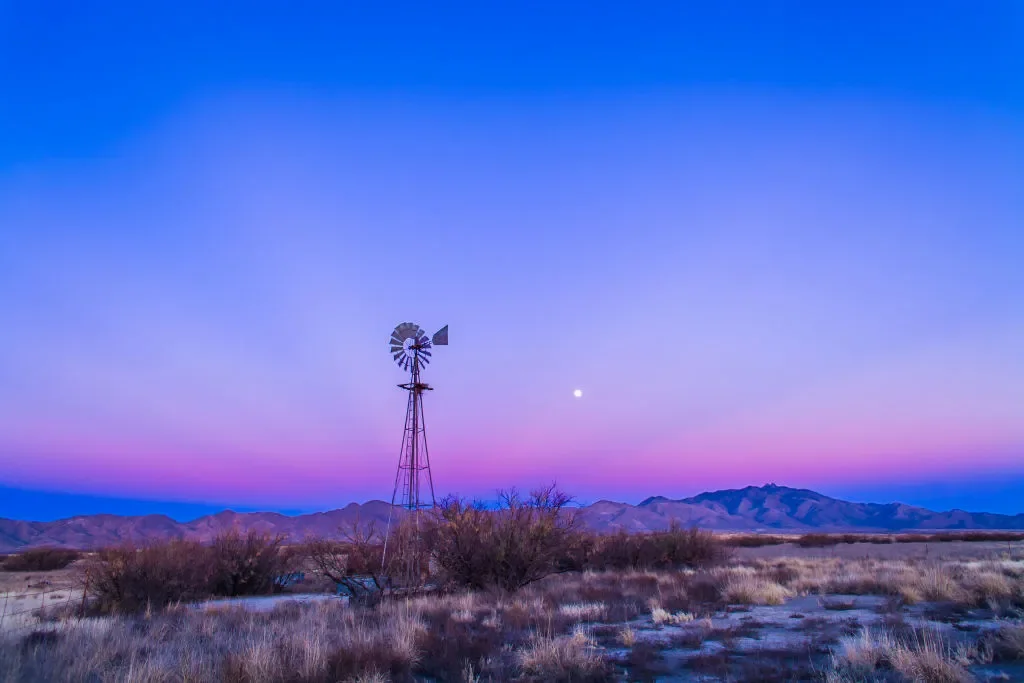
The Belt of Venus can be seen as a pink band above the eastern horizon in this image of a waxing gibbous Moon over the Chiricahua Mountains in southeast Arizona, US. Credit: Alan Dyer
Summary of the difference:
Alpenglow = indirect light on terrain (you're looking at the mountains)
Afterglow = diffuse glow in the sky (you're looking west)
Belt of Venus = pink band above Earth's shadow (you're looking east)
Why it all works: the physics of scattering
To understand why "second light" exists and why it has its pink-to-orange color, you need to know two phenomena: Rayleigh and Mie scattering.
Rayleigh scattering: why the sky is blue (and sunsets are red)
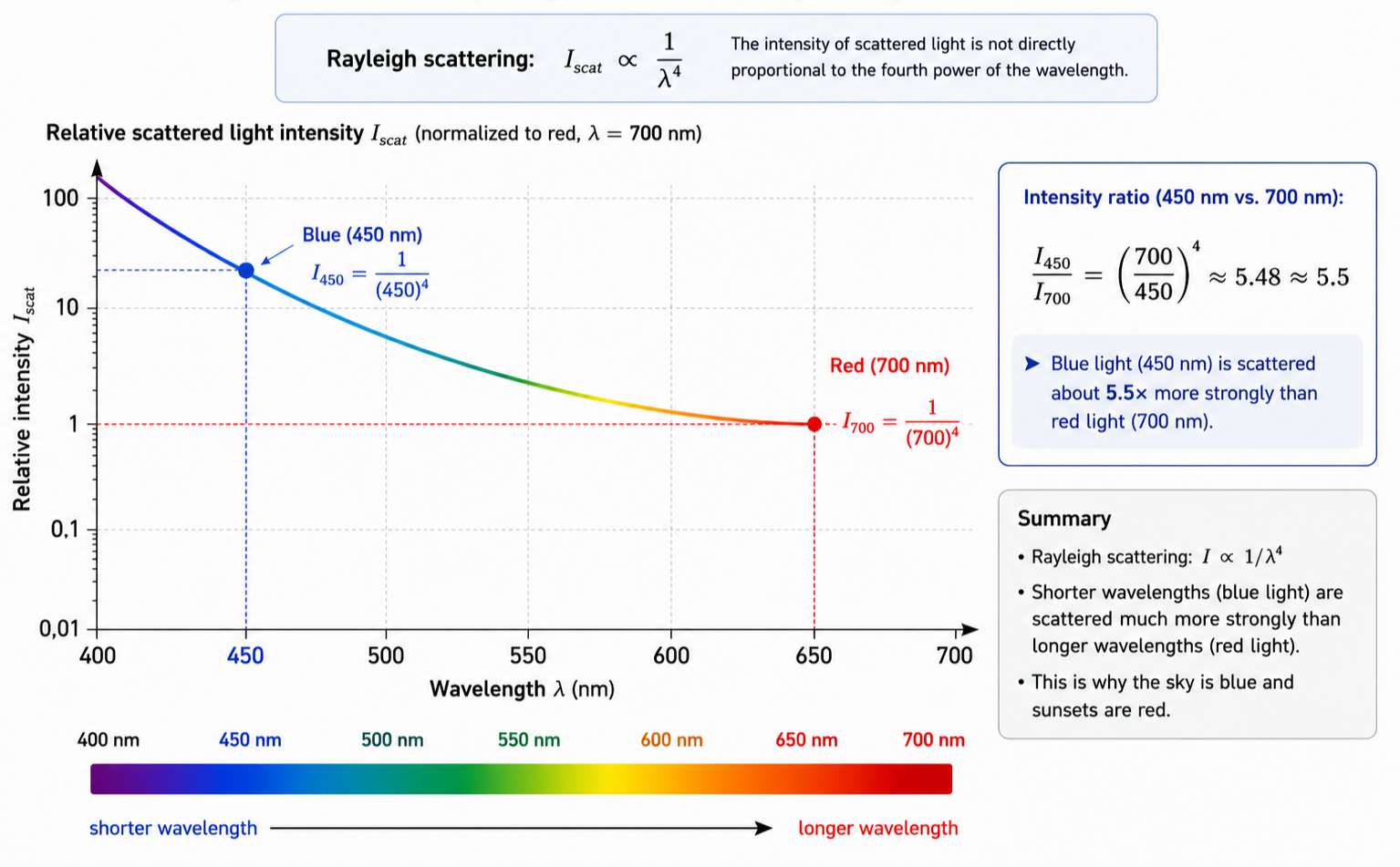
When sunlight passes through the atmosphere, it collides with air molecules — mainly nitrogen and oxygen. These molecules are much smaller than the wavelength of visible light (about 0.3 nm vs. 400–700 nm). For this size ratio, the scattering intensity is proportional to 1/λ⁴.
In practice this means blue light (~450 nm) scatters about 5.5× more strongly than red (~700 nm). That's why the sky is blue during the day — the blue rays get scattered out of the solar beam into the whole hemisphere of the sky, and we see them from every direction.
At sunset, however, the light passes through the atmosphere at a very low angle — instead of the roughly 8 km vertical thickness, it has to traverse tens to hundreds of kilometers obliquely. The blue components are almost completely scattered out along the way; only the long wavelengths get through. That's why the setting sun itself is red, and that's why the light that indirectly illuminates the upper atmosphere — and the landscape below it — is also red.
That's the physics of alpenglow in one sentence: the sun no longer shines directly, but its remaining red components scatter off the upper atmosphere and fall from above onto the elevated terrain.
Mie scattering: when particles start to matter
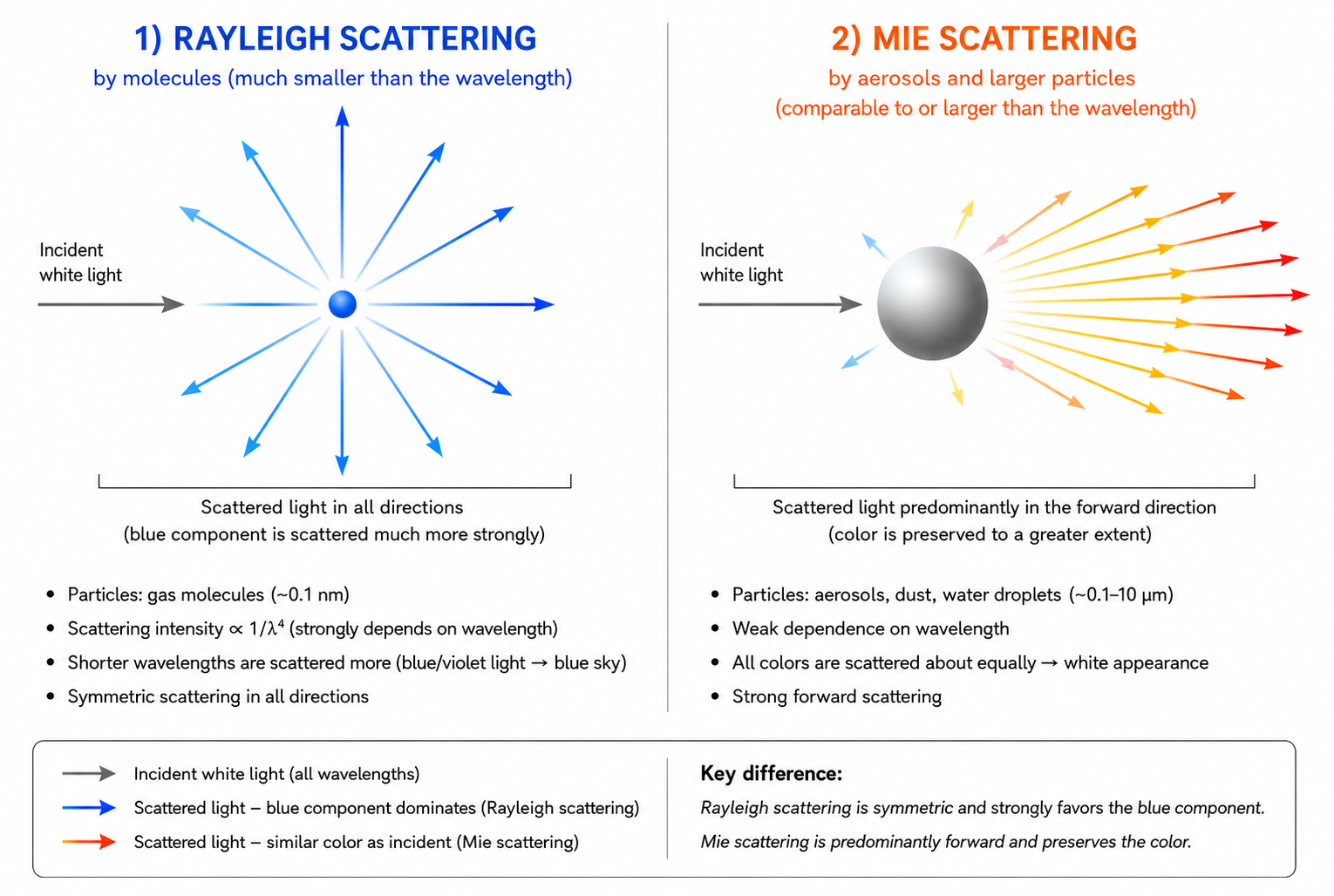
Rayleigh scattering applies to particles much smaller than the wavelength of light. Once you have aerosols in the air — dust, salt, droplets, smoke, volcanic particles — whose dimensions are comparable to the wavelength, Mie scattering takes over.
Mie scattering has two important properties:
It's less wavelength-dependent. It scatters all colors similarly, which is why a smoky sky has a whitish or yellowish tint.
It's strongly forward-directed. Most of the scattered light continues roughly in the direction the original ray was traveling, with only a small deviation.
For afterglow, this is essential. When the sun is below the horizon, its rays pass through the stratosphere at altitudes of 20–30 km. If aerosols are present there, Mie scattering "shifts" them downward and sideways — and we see them as a diffuse glow on the sky. Without stratospheric aerosols, afterglow would be much weaker and shorter.
A complete physical model of these phenomena, including multiple Rayleigh and Mie scattering, refraction, and Earth's shadow, was published by Haber, Magnor and Seidel in ACM Transactions on Graphics (2005) — a paper aimed primarily at computer graphics, but physically accurate and still widely cited.
When volcanoes enter the picture
And now to the most interesting part — why in some years sunsets appear that you've never seen before.
Krakatoa, 1883: red skies, blue moons — and rare green flashes
When Krakatoa erupted on August 27, 1883, it injected an enormous quantity of aerosols into the stratosphere — mainly droplets of sulfuric acid formed from SO₂. Over the following months these droplets dispersed globally and dramatically altered the appearance of the sky for several years.
The most common and best-documented effect was an intense red-purple afterglow. Londoners saw it every evening for months — so strong that the fire brigade was called out several times to a nonexistent fire. Edvard Munch later described the red sky over Oslo as the inspiration for his The Scream (1893). Astronomer Donald Olson of Texas State University documented in 2004 that the intensity of the sky in the painting matches what Munch could actually have seen after Krakatoa.


Alongside the red skies, however, people also reported much rarer phenomena — green sunsets and a blue-tinted Moon. These effects happened right at the horizon during the sunset itself (not as afterglow afterwards) and lasted only briefly. They survive almost nowhere in period paintings or photographs — they're described mainly in textual accounts in diaries and newspapers of the time.
A recent study in Atmospheric Chemistry and Physics (Hamill & Toon, 2024) shows why: the layer of sulfate aerosols in the stratosphere had to have a very specific particle size — around 1 micrometer — to preferentially scatter the red component of direct sunlight and let green and blue through. Combined with the normal reddening from Rayleigh scattering, this produced a rare greenish tint near the horizon. The same mechanism made the Moon blue — when observed through that same stratospheric layer.
Pinatubo, 1991: two years of unusual sunsets
The Philippine eruption of Pinatubo in June 1991 injected roughly 20 megatons of SO₂ into the stratosphere — the second-largest injection after Krakatoa in the last 150 years. Satellite measurements (USGS, Self et al.) showed that the aerosol layer spread across the entire Earth within a few months and persisted in the stratosphere for over two years.
The result: a long period of unusually colorful sunrises and sunsets, often with a visible "purple light" layer above the horizon about 25 minutes after sunset, sharp crepuscular rays, and a typically whitish, halo-like appearance of the sun itself through the aerosol layer.
What this means today
You don't need a supereruption to be at fault. Smaller events too — wildfires (Canadian 2023), dust storms (Saharan dust over Europe), industrial pollution — modulate how intense afterglow will be and what tint it will have. If you see an unusually strong or long "second light" after sunset, it's worth checking what's been happening to the atmosphere over your hemisphere in recent weeks.
Practical photo tips
Theory is nice, but here's what most interests a photographer: when, where, and how to shoot it.
Timing
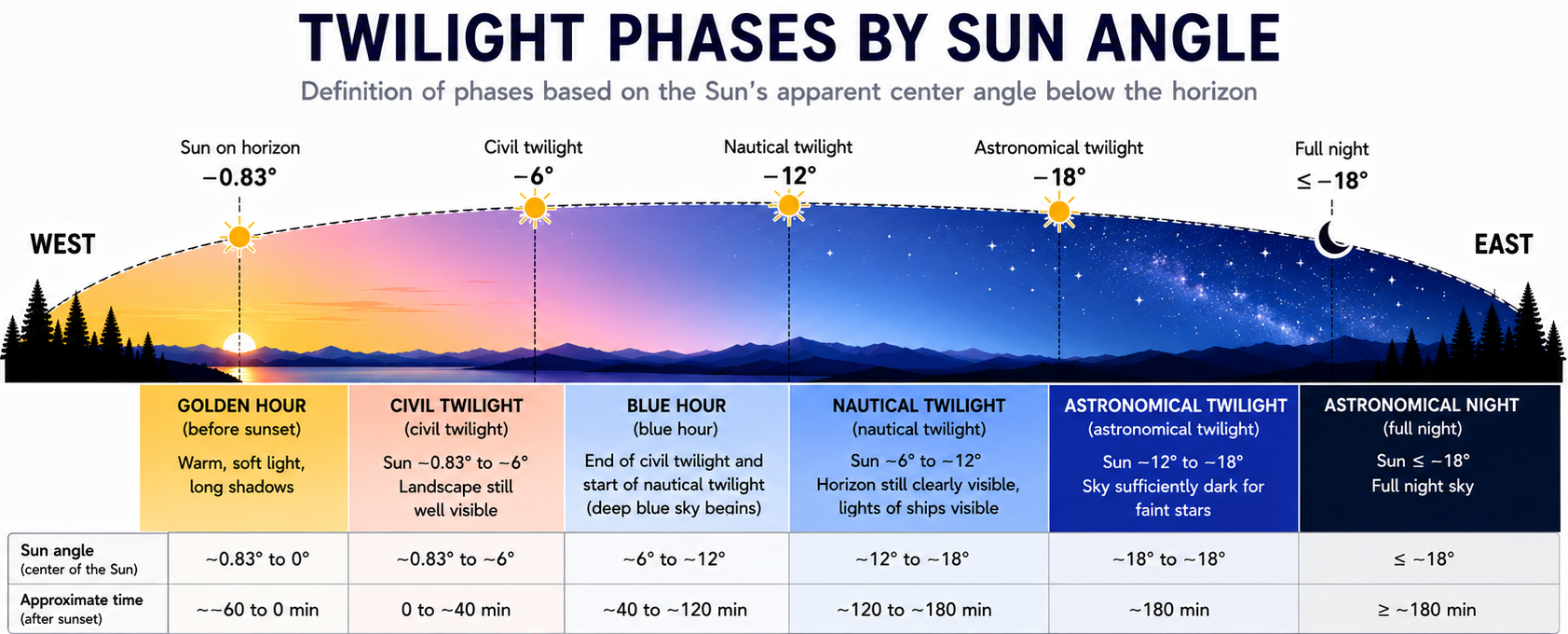
More important than the time on your watch is the sun's angle below the horizon. It helps to break twilight into phases based on where the sun is:
Civil twilight (0° to −6°): the sun has just set; alpenglow on peaks is most intense in the first 5–15 minutes. The landscape below is still well-lit, so the scene's dynamic range is manageable.
Nautical twilight (−6° to −12°): peak afterglow on the sky; the Belt of Venus in the east is most pronounced. "Blue hour" begins here — the landscape is deeply blue, the sky still colorful.
Astronomical twilight (−12° to −18°): the last colors fade, night sets in. Usable time for astrophotography begins.
The duration of each phase varies by latitude — in Central Europe, civil twilight lasts roughly 30–40 minutes in winter, longer in summer.
Gear and settings
A tripod is essential. Second light is orders of magnitude weaker than a daytime scene. Exposures run in seconds to tens of seconds.
Manual white balance. Don't let the camera "correct" that pink — that's why you're there. Set roughly 4500–5500 K manually, or shoot RAW and handle it in post (recommended).
Bracketing or a graduated filter. The lit sky and shadowed valley often differ by 5–8 EV. Either shoot RAW and handle the dynamics later, an HDR bracket, or a reverse GND filter.
Expose to the right (ETTR). In low light you reduce noise by keeping the exposure values as far right as possible without clipping highlights.
Composition
Three phenomena = three compositional approaches:
Alpenglow: find elevated terrain that will catch the light, and a dark foreground for contrast. Mountains, rock massifs, tall buildings. Key: they must be high enough for the last scattered ray to reach them.
Afterglow: the classic western sky. Look for cirrus or cirrostratus — wispy clouds at 6–12 km altitude "catch" the light most intensely. Low clouds often stay dark.
Belt of Venus: turn your back to the west. Most photographers don't, and miss one of the most beautiful phenomena of twilight. Look for a clean, uninterrupted eastern horizon, ideally with water or a simple landscape in the foreground.
Planning apps
For more serious planning, PhotoPills or The Photographer's Ephemeris are worth it — they compute the exact times of civil/nautical/astronomical twilight for a given location and date. If you want to predict the color intensity, watch the aerosol index (e.g. NASA Worldview, AOD measurements) — more aerosols = stronger afterglow.
Conclusion
Second light isn't one phenomenon but a family of atmospheric effects that appear the moment the sun disappears below the horizon but its light still finds its way through the upper atmosphere. Alpenglow lights up the terrain, afterglow paints the western sky, the Belt of Venus shows the shadow of our own planet growing on the opposite side.
Underneath it all is relatively simple physics: Rayleigh scattering filters out the blue, Mie scattering on aerosols amplifies and spreads what remains. Volcanoes and fires occasionally add their own signature, which can last for months.
For a photographer it means one thing: don't pack the tripod too soon. The best often comes fifteen minutes after everyone else has left.
References
Lee, R. L. (2015). Measuring and modeling twilight's Belt of Venus. Applied Optics 54(4): B194–B203. https://opg.optica.org/ao/abstract.cfm?uri=ao-54-4-B194
Haber, J., Magnor, M., Seidel, H.-P. (2005). Physically based Simulation of Twilight Phenomena. ACM Transactions on Graphics 24(4): 1353–1373. https://graphics.tu-bs.de/upload/people/magnor/publications/tog05.pdf
Hamill, P., Toon, O. B. et al. (2024). Explaining the green volcanic sunsets after the 1883 eruption of Krakatoa. Atmospheric Chemistry and Physics 24: 2415–. https://acp.copernicus.org/articles/24/2415/2024/
Self, S., Zhao, J.-X., Holasek, R. E., Torres, R. C., King, A. J. The Atmospheric Impact of the 1991 Mount Pinatubo Eruption. USGS. https://pubs.usgs.gov/pinatubo/self/
Cowley, L. Atmospheric Optics — reference web collection of atmospheric optics phenomena. https://atoptics.co.uk/
Lee, R. L., Hernández-Andrés, J. (2003). Measuring and modeling twilight sky colors. Applied Optics — related work analyzing the spectrum of the twilight sky.
Olson, D. W. (2004). When the Sky Ran Red: The Story Behind "The Scream". Sky & Telescope, February 2004 — the original publication of the Munch / Krakatoa hypothesis.
